
Glossary
The words, and where they come from
Santo Daime speaks four languages at once. A single work can invoke a Catholic archangel, an orixá, a forest guardian and a word Mestre Irineu made up, and mean all four seriously. These 40 entries keep each term with the tradition it came from, rather than flattening them into one vocabulary. Where an entry names a hinário, the hymns are in the archive.
Words of the doctrine
The vocabulary the tradition made for itself, or took and gave a new meaning.
- DaimeFrom the Portuguese imperative dai-me, give me — the opening of the prayer sung in the hymns: give me strength, give me love, give me light. Mestre Irineu renamed the drink with that word in 1931. It is made of two plants: the vine jagube, also called cipó, and the leaf rainha, also called chacrona.
More, and where it comes from
The imperative is the point. Dai-me is a request, not a name for a substance, and the hymns that open with it ask for strength, for love, for light. Renaming the drink with that word in 1931 moved it out of the vocabulary of remedies and into the vocabulary of prayer. Two plants are named in the hymns rather than described: the vine, jagube or cipó, and the leaf, rainha or chacrona. The naming is doctrinal — the vine is spoken of as force, the leaf as light — and the same word, rainha, does duty for the leaf and for the Queen of the Forest.
SourceHinário footnote records across the archive.
- JuramidamThe name Mestre Irineu is said to have carried in the astral. “He lived in this world with this name, but there, in the astral, he received another one, which is Juramidam,” said Luiz Mendes. The hymns use it for the spirit of the Daime itself, understood as the teacher behind every hinário received since.O CRUZEIRO, CRUZEIRINHO, DIVERSÕES
More, and where it comes from
The word does three kinds of work at once. It names a man: the name Mestre Irineu is held to have carried in the astral, which Luiz Mendes put plainly — he lived in this world under one name and received another there. It names the teacher the hymns address, the spirit of the Daime understood as the source of every hinário received since. And it names a people: Vera Fróes titled her prize-winning history The History of the People of Juramidam, and that is how the community has described itself since.
SourceVera Fróes, Santo Daime: Amazonian Culture — The History of the People of Juramidam (1983), winner of the II SUFRAMA History Award.
- MiraçãoFrom mirar, to behold — and read in the tradition as mira + ação, looking joined to acting. The word carries that double sense deliberately: the miração is not only seen but requires discernment, since the tradition itself distinguishes it from imagination and projection.
More, and where it comes from
The tradition reads the word twice over. From mirar, to behold; and as mira + ação, looking joined to acting. The hinário footnotes describe a state of communion in which one perceives one's being as spirit, and hold that recollections of previous existences may come during it. They are careful to distinguish miração from hallucination and from imagination, and hold that the hymns and the order of the work are what guide and anchor it. That is the tradition's account of its own experience and is presented here as such, not as an empirical finding.
SourceFootnotes to O Cruzeiro, Cruzeirinho, Diversões — Mestre Raimundo Irineu Serra.
- Hinário · hinoA hymnal — the complete set of hymns one person received, sung through in order from first to last. Hymns are held to be received rather than composed, and the hinários are the tradition's scripture. Mestre Irineu's is O Cruzeiro.
More, and where it comes from
O rei me mandou / Para eu cantar assimThe king sent me / to sing in this way
A hinário is one person's complete received set, sung through in order from first to last, and the order is not editorial — it is the order in which the hymns arrived. Published hinários carry that sequence with the number attached, which is why a hymn is cited as a number rather than a title: O Rei Me Mandou is 01, Fé is 02. Hymns are held to be received rather than composed, and the hinários function as the tradition's scripture. Mestre Irineu's is O Cruzeiro.
SourceHinário O Centenário — Mestre Conselheiro Luiz Mendes, official CICLUMIG edition.
- BailadoThe danced work. Three steps only — march in two, waltz in one, mazurka in three — kept in ranked lines, men on one side and women on the other. The tradition holds that the Queen of the Forest set its length by the turning of the tides.
More, and where it comes from
Mendonça and Trabulsi argue the bailado has been studied far less than the hymns, and read it as sacred dance in the lineage Bernhard and Maria-Gabriele Wosien documented in European round dances: movement as a way of entering a cosmic order rather than as accompaniment to one. Their fieldwork was done at the Estrela Brilhante church. The tradition's own account is a different kind of statement — that the Queen of the Forest set the length of the work by the turning of the tides.
SourceIsabell Mendonça & Maria Tereza Trabulsi, O Bailado do Santo Daime.
- FirmezaFirmness. The steadiness a long work asks of the body and the attention, and which the tradition says the work itself develops.
More, and where it comes from
Firmeza is spoken of as both the requirement and the result: what a long work asks of the body and the attention, and what the work is then said to develop. The word only makes full sense against the duration — works run for many hours in ranked formation — and it recurs across the archive rather than belonging to any single hymn.
- Irmandade · fraternidadeBrotherhood and sisterhood. Irmandade is the older Portuguese word for a lay confraternity — Irmandade de Nossa Senhora do Carmo, and the like. Fraternidade is the feeling rather than the body: solidarity, cooperation, love of neighbour.
More, and where it comes from
Irmandade is the institutional word before it is the affectionate one. In Portuguese it names a lay confraternity organised on religious precepts — Irmandade de Nossa Senhora do Carmo, and the like — a body with membership and obligations. Fraternidade is the feeling rather than the body: solidarity, cooperation, love of neighbour. Daime churches use both, and the distinction is worth keeping, because one describes how a church is organised and the other how its members are meant to treat one another.
SourceGlossary source record, Santo Daime workspace.
- LinhaA line: a current or phalanx of spiritual force, and by extension the ritual and the set of hymns that call it. Hence Linha de Arrochim, Linha do Tucúm.Linha De Arrochim
More, and where it comes from
A linha is a line of work — a current with its own hymns, its own beings and its own register, rather than a subdivision of an organisation. The word lets a single church hold several practices without merging them, which is why it recurs across the vocabulary: the line of Umbanda, the line of Oxóssi, the Linha do Tucúm. Oliveira's history of popular religiosity in Rio Branco between 1945 and 1958 sets out the crowded religious field the doctrine formed inside, where lines of devotion overlapped without becoming one another.
SourceRosana Martins de Oliveira, De Folha e Cipó é a Capelinha de São Francisco: a religiosidade popular na cidade de Rio Branco — Acre, 1945–1958 (UFPE, 2002).
- SalveHail. An exclamation of reverence, originally in Salve Jorge, the greeting to Saint George, and now a general Brazilian greeting as well.
More, and where it comes from
Salve is the greeting — hail, or save — and it carries into the doctrine from the Salve Rainha, the Hail Holy Queen, which is among the prayers said in the works. The prayer addresses Mary as Mother of Mercy and as the hope of the banished children of Eve, and the same word opens the vivas: Viva a Rainha da Floresta. The greeting and the prayer are the same gesture at two lengths.
SourceSalve Rainha / Hail Holy Queen, prayer record in the archive.
- DefumaçãoThe smudging that opens a work — rosemary, benzoin, lavender, sage, cedar, rue, guiné. The tradition compares it to washing the hands before a meal, and adds that it means nothing unless the conduct changes too.
More, and where it comes from
The smudging that precedes a work. Herbs are burned — rosemary, benzoin, lavender, sage, cedar, rue, guiné among them — and the practice is understood as clearing the space and the people in it. The source records are explicit that the act is not held to work on its own: the same passage that describes the herbs says plainly that a good defumação achieves nothing unless the thoughts and conduct it accompanies change too. Where a church follows the Umbanda line, specific pontos are sung during it.
SourceDefumação / Smudging record, drawn from the legacy santodaime.nextohm.com pages.
- VivasThe ritual acclamations, given standing and facing the cross, in a fixed order that begins with the Divine Eternal Father and the Queen of the Forest. They are withheld at healing works, at concentrations, on Holy Thursday and on All Souls.
More, and where it comes from
The vivas are the called salutes — Viva o Divino Pai Eterno, Viva a Rainha da Floresta, Viva Jesus Cristo Redentor, and on through the Patriarch Saint Joseph, the divine beings, Mestre Império, the whole irmandade and the Santo Cruzeiro. They are given by whoever is leading, answered by the room, and addressed to the occasion: the person whose hinário is being sung, a visiting church, a birthday. What they are not given at is as telling as what they are: the records say vivas are avoided in works of healing, in Concentration, before the Confession is sung, and on Holy Thursday and All Souls' Day.
SourceThe Vivas, record drawn from the legacy santodaime.nextohm.com pages.
The Queen, and the saints kept from Catholicism
Brazilian popular Catholicism supplied most of the calendar. The feast days below are the dates the doctrine kept.
- Rainha da Floresta · Nossa Senhora da ConceiçãoThe luminous woman Mestre Irineu saw in the moon during his forest diet, who gave him a hymn and the instruction to found a doctrine. He first knew her as the Queen of the Forest and later named her as Our Lady of the Conception. Rainha is also the name of the leaf in the drink, and a plantation of it is called a reinado — a kingdom.
More, and where it comes from
The Queen of the Forest is the figure at the origin. In the accounts of the doctrine's beginning she is the one who gives Mestre Irineu the teaching and sets the form of the work, and she is identified in the tradition with Our Lady of Conception. Meyer's study of those origin accounts places her alongside two other figures — the seringueiro, the rubber tapper, and the caboclo — and argues the three together carry how the tradition tells its own beginning.
SourceMatthew Meyer, The Seringueiro, the Caboclo, and the Forest Queen: Origin Myths of the Santo Daime Church (University of Virginia, 2003).
- JesusCentral to the doctrine as Redeemer, and named in the hymns by all four of those titles. Mestre Irineu described the Daime itself as the blood of Christ.
More, and where it comes from
Christ is addressed in the hymns and in the vivas as Redentor, the Redeemer, and the doctrine's Christian frame is not decorative: the prayers said in the works are Catholic prayers, and the calendar of feasts is a Catholic calendar. Rehen's study of Daime music outside Brazil traces how that frame travels — what the hymns carry when they are sung in a place with no Catholic background to rest on.
SourceLucas Kastrup Rehen, Música no Santo Daime na Holanda (doctoral thesis, 2013).
- São João BatistaPatron of the doctrine. The first hinário in Santo Daime history was sung on his vigil in 1935, and his feast is still the most festive night of the year, carrying the bonfires and the forró of the Brazilian Festa Junina.Flores de Sao Joao
More, and where it comes from
Patron of the doctrine. The hinário footnotes fix on one moment: John testifying to the light at the Jordan — there is the true Light — and read that act of witness as what links him to the doctrine's understanding of spiritual testimony. The Gospels place him in the Judean desert in camel hair, living on locusts and honey, and scholarship has linked that asceticism to the Nazarite vow and to the Essene communities at Qumran. In Brazil his feast on 24 June is also one of the largest popular festivals of the year, part of the Festas Juninas with Santo Antônio on the 13th and São Pedro on the 29th, and it falls near the solstice and the harvest. In the Daime it is among the most important days in the calendar.
SourceFootnotes to O Cruzeiro, Cruzeirinho, Diversões — Mestre Raimundo Irineu Serra; feast-day records in the archive.
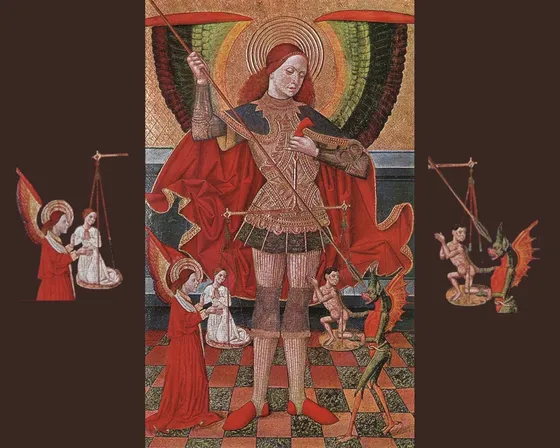
- São Miguel ArcanjoThe archangel invoked against fear, despair and loss of faith. His hymns serve twice over: a calendar feast in September, and a healing line whenever it is called for.São Miguel
More, and where it comes from
The archangel is honoured with a rosary of his own, structured as nine salutations to the nine angelic choirs — Seraphim, Cherubim, Thrones and on — each with its own petition, followed by four beads for the archangels and the guardian angel. Padrinho Alfredo's hinário São Miguel, a hundred hymns, is used both as a calendar feast and as a line of healing, which is why the name appears twice in the archive: once as a figure and once as a hinário.
SourceRosário de São Miguel Arcanjo, prayer record in the archive; author biographies.
- São SebastiãoThe Roman soldier shot with arrows, left for dead and healed by Irene before being beaten to death on his return to Diocletian. In the Afro-Brazilian correspondences he is read as Oxossi, the hunter — though the same tables elsewhere give him as Ogum.São Sebastião
More, and where it comes from
The apocryphal acts attributed to Ambrose of Milan have him enlisting in the Roman army around 283 to strengthen Christians facing torture, made captain of the praetorian guard, condemned as a traitor for leniency toward Christian prisoners, and shot with arrows — which became his constant iconography. He survived that, presented himself to Diocletian again, and was beaten to death. The pairing with Oxóssi the hunter runs through the arrows. It is not fixed: other sources give Saint Sebastian as Ogum, and the glossary keeps both rather than choosing.
SourceHinário footnote record, SD São Sebastião (Saint Sebastian / Oxóssi).
- São JorgeBeheaded at Nicomedia in 303. The dragon he kills is read as the plain figure of good over evil; in Umbanda and Candomblé he is Ogum, warrior of iron and of the roads, which makes him particularly present in works of healing and spiritual battle.
More, and where it comes from
A Roman soldier of the persecution under Diocletian, beheaded at Nicomedia in 303. The dragon belongs to legend rather than to history, and became the most reproduced image in Christian iconography — faith over fear, rendered as a fight. In Brazil he is among the most venerated saints in both Catholic and Afro-Brazilian practice, identified in Umbanda and Candomblé with Ogum, the orixá of iron, roads and battle. Salve Jorge is an ordinary Brazilian exclamation long before it is a religious one.
SourceSaint George / São Jorge feast-day record in the archive.
- Santo AntônioThe Franciscan of Lisbon who died at thirty-six in Padua and was canonised the following year. Patron of the poor and of lost things; in the doctrine he is also the patron of guardianship.
More, and where it comes from
The first of the three June saints, on the 13th. Russo Júnior's fieldwork on the conversations between Santo Daime and Umbanda is the closest study of how figures like this one move between the two — not as a table of equivalences but as a practice worked out differently in each house.
SourceAlvaro Antônio Russo Júnior, Na Boca da Mata: diálogos entre santo daime e umbanda (MA, Social Anthropology, USP, 2016).
- São PedroThe fisherman of Bethsaida named Kepha, the stone. Crucified upside down at his own request under Nero. With Anthony and John he completes the three June feasts.
More, and where it comes from
Simon the fisherman of Bethsaida, brought to Christ by his brother Andrew at John the Baptist's suggestion, and renamed Kepha — stone in Aramaic, Petros in Greek. He was sent to Rome under Nero and executed there; the tradition holds he asked to be crucified upside down, thinking himself unworthy of dying as Christ had. His feast on 29 June closes the Festas Juninas. In the Daime he is kept as the holder of the keys and the protector of fishermen and of humble workers — which in Acre is not an abstraction.
SourceFootnotes to SD Ocasiões Especiais (Special Occasions).
- São LonguinhoThe centurion who named Christ the Son of God at the cross, and who tradition merges with the soldier of the spear — his name comes from the Greek word for one. Invoked, like Anthony, for things that have gone missing.
More, and where it comes from
The centurion who at the crucifixion recognised Christ as the Son of God, and who is identified with the soldier who pierced his side — probably because the name derives from the Greek for spear. The account has the water from the wound reaching his eyes and curing an illness in them, after which he left the army and became a monk. He is invoked for things that have been lost, which in Brazil is a household devotion long before it is a liturgical one. His feast is 15 March in Brazil and Spain, 16 October in Eastern Europe.
SourceSaint Longinus / São Longuinho record in the archive.
- São Francisco de AssisFounder of the Franciscans. His poverty, his service and his regard for the natural world sit close to the doctrine's own emphases, and his prayer is among the most widely sung in the tradition.São Francisco
More, and where it comes from
Francis matters here for a local reason as well as a universal one. Oliveira titled her history of popular religiosity in Rio Branco after a chapel of his — de folha e cipó é a capelinha de São Francisco, of leaf and vine is the little chapel of Saint Francis — and the study describes the crowded devotional life of the city between 1945 and 1958, the years in which the doctrine was taking its form there. Leaf and vine are also the two plants named in the hymns, which is part of why the line carries in this vocabulary the way it does.
SourceRosana Martins de Oliveira, De Folha e Cipó é a Capelinha de São Francisco: a religiosidade popular na cidade de Rio Branco — Acre, 1945–1958 (UFPE, 2002).
- Nossa Senhora AparecidaThe small dark terra-cotta Virgin drawn from the Rio Paraíba in two pieces by fishermen around 1717, after a night of empty nets — and then a catch so heavy they feared for the boats. Patroness of Brazil.
More, and where it comes from
The story is specific and worth keeping specific. In 1717, fishermen on the Rio Paraíba, ordered to catch fish for a passing governor, worked all night without success; João Alves pulled up the body of an image of Our Lady of Conception, then on the next cast her blackened head. The pieces fitted. The catch that followed was so heavy they feared for the boats. The figure is a small dark terracotta Virgin, and she became patroness of Brazil, succeeding Our Lady of Conception, who held that office under the Empire. Her feast, 12 October, is a national holiday. In the Daime she is honoured within the communion of Marian apparitions, and is one of the points where the Catholic and Afro-Brazilian streams meet — a dark Virgin drawn out of the water.
SourceFootnotes to SD Ocasiões Especiais (Special Occasions).
- Nossa Senhora do Perpétuo SocorroA fifteenth-century Byzantine icon in Rome, in which the Child looks not at the viewer but at the instruments of the Passion. Invoked in the doctrine especially at works of healing.
More, and where it comes from
A fifteenth-century Byzantine icon, in Rome since 1499 and enshrined at Sant'Alfonso di Liguori, where its novena is prayed weekly. In the Eastern churches the same iconography is the Virgin of the Passion, named for the instruments of the Passion the angels carry in the image. Its spread is a matter of record: Pius IX entrusted it to the Redemptorists in 1865, it was canonically crowned in 1867 under its present title, and it has been reproduced since in homes, shops and buses across Brazil.
SourceOur Lady of Perpetual Help record in the archive.
The Afro-Brazilian lines
Present in the doctrine from Maranhão, and formally part of ritual practice in the ICEFLU line. The sources are explicit that this differs by lineage: at Alto Santo the works stay closer to a plain Christian practice.
- UmbandaThe Brazilian religion of African matrix that joins Candomblé, Spiritism and Catholicism, founded through the medium Zélio Fernandino de Moraes and the spirit Caboclo das Sete Encruzilhadas. Its orixás carry Catholic correspondences, and many hinários in this archive are dedicated to its entities.Baixinha
More, and where it comes from
Umbanda is its own religion, not a department of the Daime. It enters the doctrine as a line of work, and how far it enters is the sharpest difference between lineages: Umbanda works are central at ICEFLU and largely absent at Alto Santo. Russo Júnior's fieldwork treats the two as being in dialogue rather than in hierarchy, which is the honest frame — any sentence beginning "in Santo Daime, the orixás…" needs a lineage attached to it.
SourceAlvaro Antônio Russo Júnior, Na Boca da Mata: diálogos entre santo daime e umbanda (MA, Social Anthropology, USP, 2016).
- Os Pretos VelhosSpirits who lived and died in slavery and freed themselves through spiritual illumination — pictured as elders bent under lived wisdom, white-haired, with a pipe. Their day is the thirteenth of May, the date the Lei Áurea ended slavery in Brazil.Chaveirinho
More, and where it comes from
The old black spirits — understood in Umbanda as the souls of Africans who were enslaved in Brazil and who work now in charity, giving counsel and healing. They are pictured bent under the weight of what they know, white-haired, with a pipe; in the African sense that lies behind the figure, velho means experienced rather than aged. Their day is 13 May, chosen in analogy with the signing of the Lei Áurea that ended slavery in Brazil — though the sources are careful to say that the liberation the day marks is held to have happened inwardly, not in law. They appear in the Umbanda works of some Daime lineages.
SourceOs Pretos Velhos record in the archive, with a 2022 text by Maria Alice Campos Freire; footnotes to Chaveirinho, Chaveirão — Glauco Villas Boas.
- Exu Tranca RuaCaptain of the crossroads, defender of women and of the oppressed, commanding a falange divided in seven. The cult is tied to the day of São Bartolomeu and to Oxumaré, who carries souls from earth to heaven.
More, and where it comes from
Guardian of the crossroads and of the paths — the name means street-blocker, and the sense is a gate that can be opened as well as shut. He is honoured on 24 August, a date the Catholic calendar gives to Saint Bartholomew and which one account ties to the massacre that began on that night in 1572. He commands a falange with seven subdivisions and is spoken of as a defender of women and of the oppressed. A biography circulates too — a Galician named Geraldo Branco Compostella, a healer who worked with herbs and bark. None of this is Daime doctrine; it is the Umbanda material the Umbanda works bring with them.
SourceExu Tranca Rua record in the archive, citing the babalorixá Lucas Irain de Souza and the ialorixá Mãe Nagetu.
- Iemanjá · JanaínaThe feminine principle of creation and of moonlight, protector of fishermen and of those who survive shipwreck; her offerings are flowers, perfume, mirrors, sent out onto the sea. Identified variously with Our Lady of Navigators and with the Immaculate Conception.O Justiceiro
More, and where it comes from
Queen of the Ocean; the feminine principle of creation, moonlight, protector of fishermen and of those who survive shipwreck. Janaína is the young Iemanjá. Offerings are flowers and feminine things — perfume, jewellery, mirrors — set in baskets and given to the sea, principally on 2 February. She is identified in the syncretic frame with Nossa Senhora dos Navegantes and with the Immaculate Conception; two Catholic counterparts for one orixá, which the glossary keeps rather than resolves. In the Daime she appears in the Umbanda works and is linked to the Rainha da Floresta as another expression of the divine feminine.
SourceFootnotes to O Justiceiro — Sebastião Mota de Melo.
- NanãMatriarch of the orixás, Lady of the Depths, owner of the mud that humanity was made from — the eldest of them all, and in Afro-Catholic correspondence Saint Anne.
More, and where it comes from
TuperciThe hymn in which Nanã is read as the flower not yet understood
The eldest of the orixás — grandmother of creation, owner of the mud humanity was formed from, Lady of the Depths, presiding over the primordial waters and over the mystery of life and death. She is usually syncreted with Saint Anne. In the Daime she arrives through commentary on Mestre Irineu's hymn Tuperci, where she is read as the deep feminine wisdom that precedes understanding — the thing the hymn's speaker does not yet grasp.
SourceFootnotes to O Cruzeiro, Cruzeirinho, Diversões — Mestre Raimundo Irineu Serra.
- Obaluaê · AtotôOrixá of healing and of the earth. Atotô Obaluaê is the greeting: silence for the great king of the Earth. Son of Nanã, raised by Iemanjá.
More, and where it comes from
Orixá of healing, of mystery and of the earth, held to turn negative force into positive. Son of Nanã, raised by Iemanjá. The greeting Atotô — silence for the great king of the earth — is what the name is usually met with, and it appears in the hinários of the Baixinha lineage, calling for the quiet that recognition is supposed to take.
SourceFootnotes to Hinário da Fé — Baixinha.
- OmolúOrixá of death and transformation, owner of the cemetery, who conducts those passing out of life. Syncretised with São Lázaro, and in some houses the same figure as Obaluaê.
More, and where it comes from
Orixá of death, disease and transformation; in Candomblé houses the one who accompanies those passing out of life, and the owner of the cemetery. He is syncreted with São Lázaro. In the Daime calendar he arrives around Todos os Santos e Finados, the first and second of November, where his role as guardian of the passage fits the doctrine's reading of death as a crossing rather than an ending. Omolú and Obaluaê are the same orixá under different names in some traditions and distinguished in others.
SourceFootnotes to SD Ocasiões Especiais (Special Occasions).
- TerreiroThe consecrated ground, usually open-air, where Afro-Brazilian rites are held. Daime works happen indoors, but the terreiro is the inheritance behind how its Umbanda works are understood.
More, and where it comes from
The consecrated ground where Umbanda rituals are held, usually outdoors. Daime churches work indoors, so the terreiro is not their room. What carries over is the idea rather than the place — a space set apart, where the physical and spiritual worlds are held to meet — and that is how a work of Umbanda inside a Daime church is understood.
SourceFootnotes to Chaveirinho, Chaveirão — Glauco Villas Boas.
The forest
Beings and figures of the Amazon, which the doctrine took in as it found them.

- CurupiraShort, red-haired, with his feet turned backward so that his tracks lead the wrong way. He protects the trees and the animals and torments those who destroy them — though he is fair, and leaves in peace anyone hunting to eat. Children he takes return after seven years, taught.
More, and where it comes from
Small, red-haired, with his feet turned backwards so that his tracks lead the wrong way. He guards the trees and the animals, and what he punishes is predation rather than hunting: the accounts are consistent that he grants peace to those taking what they need and torments those who take more. He whistles, he makes illusions, he walks people in circles until they are lost. The hinário footnotes give him a longer name, Currupipipiraguá, and a habit of knocking on hidden trunks before a storm to tell the forest it will hold. In the Daime he belongs to the reading of the forest as inhabited — plants, animals and beings that are part of the spiritual world the works engage.
SourceCurupira record in the archive; footnotes to Hinário da Fé — Baixinha.
- Beija-florFlower-kisser. The bird that hovers, and flies backward, and drinks from the flower — which is why the tradition reads it as a figure for spiritual agility, and why the members of the Linha de Arrochim are called its hummingbirds.
More, and where it comes from
The hummingbird. In the forest vocabulary of the hymns it is one of the beings of the place rather than an image drawn from outside it — the same reading that makes the forest inhabited rather than scenic.
- Mãe d'Água · TarumimWater mother, and provider of sacred wisdom rather than only of water — a figure standing where the Tambor de Mina and pajelança of Maranhão meet the river spirits of the Amazon. She is named in Mestre Irineu's hymn Formosa.O Cruzeiro
More, and where it comes from
Mother of the Waters — the river's own feminine power, and one of the points where the forest vocabulary and the Afro-Brazilian one are hard to separate: she is spoken of alongside Iemanjá without being simply identified with her.
- Linha do TucúmThread hand-twisted from the young leaves of the tucúm palm, made at Céu do Juruá in Amazonas — gathered without killing the palm, and entirely biodegradable. It is also the name of a hymn, sung as a hymn of strength.
More, and where it comes from
Tucum is an Amazonian palm, and the ring cut from its black shell is worn as a sign. The line named for it carries that plainness with it — a mark made from what the forest already provides rather than from anything bought.
Places and people
- Alto SantoOriginally Alto da Santa Cruz — the land some seven kilometres outside Rio Branco that the community moved to in May 1945, after the police raid of 1942. Mestre Irineu lived and died there, and the line that stayed carries its name.
More, and where it comes from
The church of Mestre Irineu's own line, in Rio Branco, Acre. The distinction that matters most across the glossary runs through here: Umbanda works are largely absent at Alto Santo and central at ICEFLU, so a statement about Santo Daime practice is usually a statement about one lineage. Oliveira's history of Rio Branco in the years the doctrine was forming describes the city and the religious field it grew inside.
SourceRosana Martins de Oliveira, De Folha e Cipó é a Capelinha de São Francisco (UFPE, 2002).
- Vila Céu do MapiáThe community Padrinho Sebastião's people founded on the Mapiá stream, off the Purus. In 1989 the surrounding land became a national forest. It is the seat of ICEFLU, with about a thousand residents.
More, and where it comes from
The community in the Amazonian interior founded under Padrinho Sebastião's line, and the reference point for the expansion that followed — the churches abroad that Rehen studied are downstream of it in every sense.
SourceLucas Kastrup Rehen, Música no Santo Daime na Holanda (doctoral thesis, 2013).
- Padrinho · MadrinhaGodfather and godmother. The titles the tradition gives its leaders — Padrinho Sebastião, Padrinho Alfredo, Madrinha Rita.
More, and where it comes from
Godfather and godmother — the words a lineage uses for the person who carries it. They are kinship words doing institutional work, which is the same move irmandade makes: authority described as family rather than as office.
- PuxadoraThe lead singer, always a woman, seated nearest the altar. She begins every hymn, sets the tempo and holds it, and carries hinários of a hundred hymns and more from memory. The instruments follow her and the congregation follows them.
More, and where it comes from
The woman who pulls the hymn — who starts it and sets its pace, so that a room of many voices begins together. The role is the practical hinge of a long sung work, and it is one of the places where the music of the doctrine is organised rather than simply performed.
SourceLucas Kastrup Rehen, Música no Santo Daime na Holanda (doctoral thesis, 2013).
- Fardado · fardadaA member who has been through the fardamento and wears the farda, with the six-pointed star pinned to it. Those who have not are paisanos, and take the last places in the line, behind the fardados.
More, and where it comes from
To be fardado is to have been through the fardamento and to wear the farda with the six-pointed star. The distinction it creates is visible in the room: those who are not fardados are paisanos and take the last places in the line. Uniform is the ordinary meaning of farda in Portuguese — it is a soldier's word, and the doctrine keeps that sense rather than softening it.
On the correspondences
The saint-to-orixá pairings above are the ones the sources give, and they are not consistent with one another: Saint Sebastian is Oxossi in one place and Ogum in another, and Iemanjá appears twice with two different Catholic counterparts. Correspondences of this kind were never a fixed table; they differ between houses, between regions and between lineages, and the doctrine's own practice differs too — Umbanda works are central at ICEFLU and largely absent at Alto Santo.
For the calendar these feast days belong to, see works; for the people, history.