
Symbols
Two forms, and what they carry
Santo Daime uses very few emblems, and the two that matter are both older than it by a long way. A cross with a second crossbar, and a star with six points. Neither was invented here; both were given meanings here that are specific to the doctrine.
The Cross of Caravaca
A cross with two horizontal bars — also called the patriarchal cross, and in France the Cross of Lorraine. The second bar is the titulus, the tablet Pilate had fixed above Christ's head reading Iesus Nazarenus Rex Iudaeorum. The tradition reads the two bars as the two natures of Christ, divine and human.
The name comes from Caravaca de la Cruz in Spain, where a relic said to be a fragment of the True Cross is kept — one of the Catholic jubilee cities. The same form is carried before the Pope in processions, and in the twentieth century it became the emblem of the French Resistance. In Santo Daime it stands at the centre of every altar, and it stands for the redemption of humanity through the sacrifice of Christ and the continuation of that mission on earth.
It replaced a single-barred cross in the late 1930s. Mestre Irineu's hinário carries its name: O Cruzeiro.
The six-pointed star
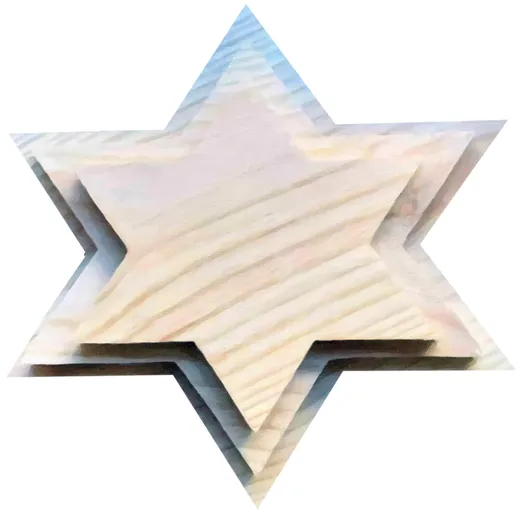
Two triangles interlocked — the upward one read in the esoteric traditions as fire and the divine masculine, the downward one as water and the divine feminine. Their union is the whole point of the figure: heaven and earth joined, and humanity as the result of that joining.
The tradition is careful about the star's history, and says plainly that it predates the Jewish faith — it appears decoratively and magically in the ancient world, and in Hindu and Buddhist contexts, before it becomes the Star of David and a mark of Jewish identity from around the seventeenth century. In Theosophy and Hermeticism it is the hexagram, the figure of balance.
In Santo Daime it belongs to the Queen of the Forest, and every member who goes through the fardamento receives one to wear. The star is pinned to the uniform by the leader, or by other fardados when there are many at once — and receiving it is the moment a member chooses where to serve: singing, playing, or guardianship.
The flag
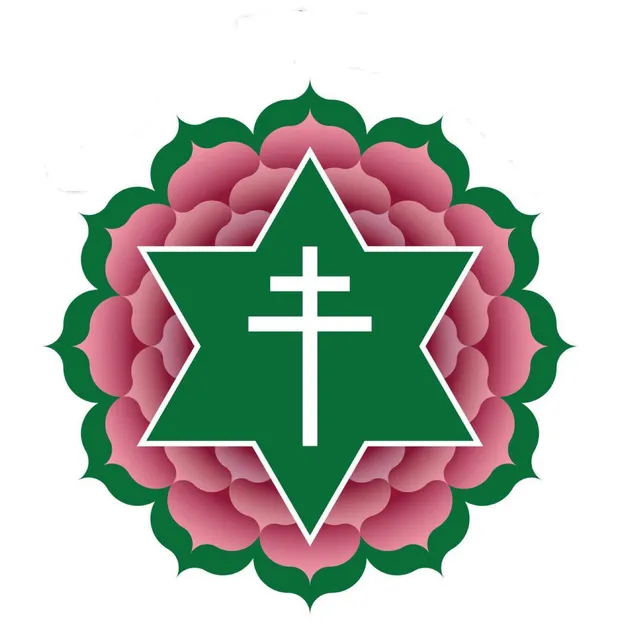
A white diamond on green, carrying the cross and the star together — the construction quotes the Brazilian national flag directly. The essay the tradition keeps on this reads the green as the forest, as the indigenous peoples of it, and as the colour of the heart chakra and of hope; the white diamond as purity, the same purity the national flag's diamond stands for and the same the white farda stands for.
The two emblems in the centre are simply the two emblems of the doctrine, put in one place: the cross for the mission of Christ, the star for the union of heaven and earth.
The altar
Rectangular or star-shaped, at the centre of the hall. On it: the Cross of Caravaca; four candles for the Sun, the Moon, the Stars and all Divine Beings; photographs of Mestre Irineu and of the elders of the tradition; images of the Virgin and the saints; and fresh flowers. Vivas are given standing, facing it.
Colour
Colour in this tradition is worn rather than displayed, and it names the kind of work rather than the person. White is for the danced hinário works and the great calendar feasts; blue for concentrations, healing works and the mass for the departed. Mediums work in white. The flag's green is the forest, and its white is the same white as the farda.
Where this page stops
The sources describe the cross, the star, the flag and the altar, and very little else. They do not describe the crown, and the maracá — the rattle carried in the dance — does not appear at all, though it is the most audible object in any bailado. Rather than fill those in from elsewhere, this page leaves them out. The account of the flag is itself muddled about its construction, calling green the background in one paragraph and white in the next.
For what the star means in practice, see fardamento; for the works the colours name, works.