A work is a ritual, and in this doctrine the ritual is mostly singing. What separates one work from another is the posture — seated or danced — the colour worn, and which hinário the calendar calls for. This page sets out the forms and points to the hymns themselves.
The hall
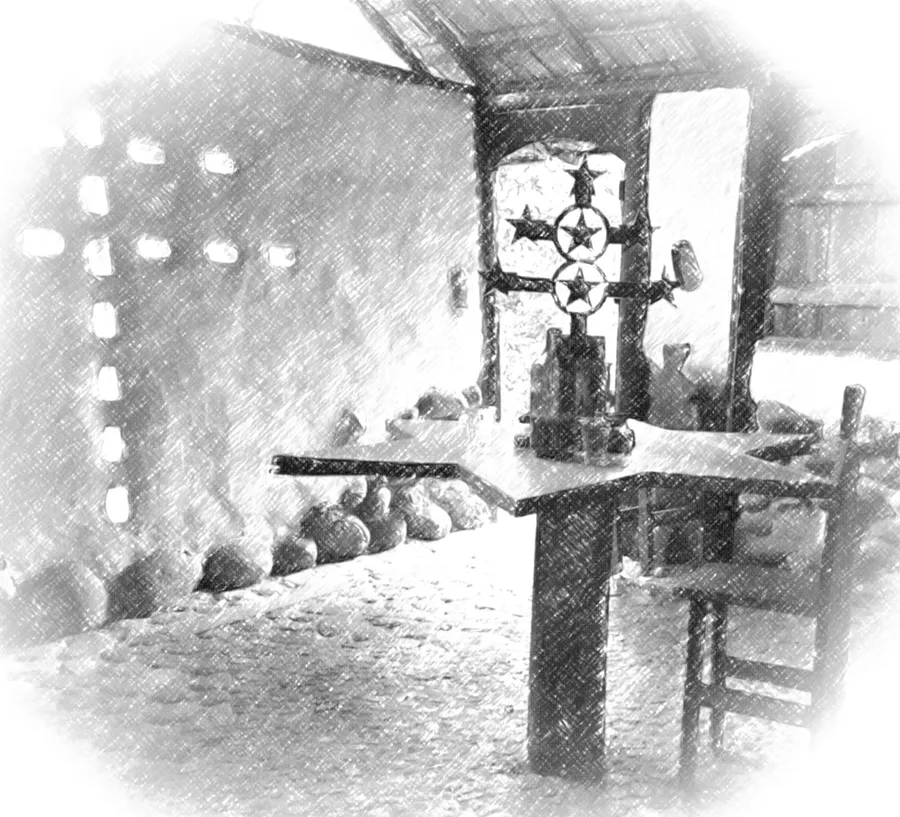
The salão is rectangular or star-shaped, with a central altar carrying the double-barred Cross of Caravaca, four candles for the Sun, the Moon, the Stars and all Divine Beings, photographs of Mestre Irineu and the elders, and fresh flowers. Men stand or sit to the left of it and women to the right. A puxadora — always a woman — sits nearest the altar on the women's side and leads every hymn; the instruments follow her and the congregation follows them. Every work opens with the defumação, the smudging, and opens and closes with prayer: the Our Father, the Hail Mary, the Salve Regina and the Creed.
An altar table with the double-barred cross at its centre. The image is a stylised illustration rather than a photograph.
The recurring works
Four forms return through the year on their own rhythm, independent of the calendar of feasts. They differ in posture, in dress and in what the singing is for.
ConcentraçãoConcentration
Seated work
Blue farda
Twice a month — the sources give the 15th and the 30th
Seated, in silence
The first form Mestre Irineu received, and the plainest. The congregation sits, and for a long stretch nothing happens outwardly at all: no dancing, no instruments, no speech. The collection sung around that silence opens with Oração and closes with a Chave — a key.
Because it asks least of the body and most of the attention, it is the form newcomers meet first.
The dancing work, and the most formal. A hinário is sung through from its first hymn to its last while the congregation dances — three steps only, one for each rhythm: march in two, waltz in one, mazurka in three. The commander takes the first step to the left after the opening verse and the lines follow.
The fardados stand in lines ordered by height, men to the left of the altar and women to the right, with visitors behind them. The tradition holds that the Queen of the Forest set the length of the bailado by the turning of the tides.
Santa MissaHoly Mass
Mass for the departed
Blue farda
First Monday of the month, after four in the afternoon — and after a death in the community
Seated in the salão
Ten hymns for the dead: six of Mestre Irineu, two of Germano Guilherme, one of João Pereira and one of Joaquim Português. On the day of the dead, and when a brother or sister has passed, nine prayers are said between them.
It follows the shape of the Catholic Requiem, slowed and set to hymns. It is sung for those who died in the month just ended.
The days on which the drink is made, by the whole community, under ritual discipline from the first cut to the last pot. The tradition calls it the most important work of all, and reads the cooking as a figure for the community itself: what rises to the surface of the pot is skimmed away.
This site describes the feitio as a rite. It gives no method.
Works of healing
Held apart from the ordinary calendar and often apart from the church building — at a Casa da Saúde, or in a member's house.
CuraHealing work
Healing
Blue farda
The person being prayed for is seated at the centre
The whole congregation's attention is turned toward one person who is ill, or toward the community at large. The hymns sung call on a wide range of company — the archangels and Christ, the constellations, the forces of the forest, and the entities of the Afro-Brazilian lines.
A linha, in this vocabulary, is a current of spiritual force and equally the set of hymns that calls it. Arrochim is named in those hymns as um beija-flor, a hummingbird; members of the line are sometimes called beija-flores of the Queen of the Forest. The invocation is made a nove pontos — to nine points.
The table works for mediumship and esoteric study — the rarest form in the tradition, and the one closest to its Kardecist and Umbanda inheritances. Mediums work in white, under the supervision of experienced leaders.
The calendar
Fixed dates, mostly Catholic, that the doctrine kept. On each of them churches across the world sing the same hinário on the same night.
Nossa Senhora da ConceiçãoImmaculate Conception
Feast
December 8
The feast of the figure Mestre Irineu first knew as the Queen of the Forest and later named as Our Lady of the Conception. Of all the dates in the year this is the one closest to the doctrine's own origin.
Natal e Dia de ReisChristmas and Epiphany
Feast
December 25 and January 6
The Nativity and the coming of the Kings, both kept as danced works in white.
Sexta-Feira SantaGood Friday
Feast — movable
One of the most solemn nights of the year. Since 1964 it has carried a Bendito — a Catholic song of praise that Francisca Mendes learned as a child of nine from women of Ceará in the Cris Perét quarter of Rio Branco, who sang it at the end of the terço during the month of May. She brought it to Mestre Irineu at the end of 1963; he liked it and ordered it sung.
São JoãoSaint John
Feast
June 23 – 24
Through the night
The first São João in the doctrine was kept in 1935, and the tradition dates the first hinário ever sung to that vigil. It is the year's most festive night, carrying the bonfires and the forró of the Brazilian Festa Junina into the work.
The archangel is kept both as a calendar feast and, separately, as a healing line — the same hymns serve a white work in September and a blue work whenever they are needed.
The gravest night of the year. No vivas are given. The Santa Missa may be folded into it, and the singing is turned entirely toward the souls in the astral. Four hinários in this archive were received for it.
He died at nine in the morning on July 6, 1971, at Alto Santo. His body was laid in the centre of the hall in white farda; the principal hinários of the doctrine were sung through that day and all that night, and the coffin went out the next morning under the Brazilian flag, carried by his companions, with the police band behind it. Each year his hinário is sung again on the date.
Mestre Irineu's hinário is given as 129 hymns in one account and 132 in another; the combined volume in this archive holds 136 entries across O Cruzeiro, the Cruzeirinho and the Diversões, so none of the three numbers is counting the same thing. All Souls is filed among the white danced works and described elsewhere as a silent seated vigil, and the Mesa Branca is called at once the rarest form in the tradition and the most important. Where a page here is silent on a colour or a length, it is because the sources are.
The Liturgia document in the archive carries the prayer texts themselves, and Ocasiões Especiais carries the calendar. This page is a description of practice, not an invitation to it, and gives no guidance on attending, preparing or taking part.